
By Izzy Teng
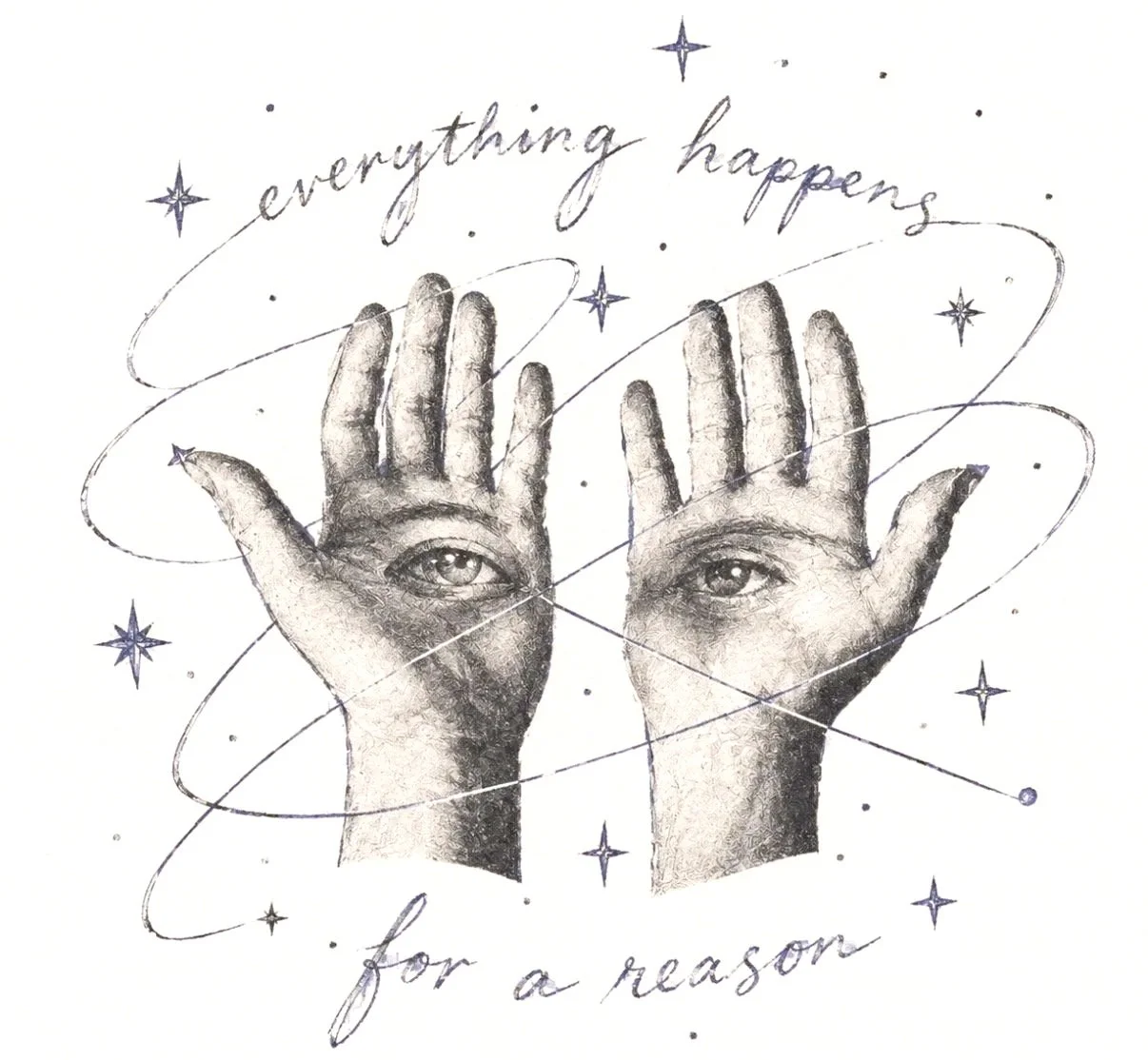
Everyone has heard the phrase: everything happens for a reason. But—excuse my Carrie Bradshaw-isms—I can’t help but wonder, does everything actually happen for a reason?
I certainly hope so. It would be nice if life came with footnotes. As I begin the transition into one of the most change-oriented periods of my life, I've found myself rewinding. I, like many, have spent my life thus far depositing into a future I’ve yet to see. I’ve studied for the grades and worked for the job. I’ve loved with the expectation that somebody loved me back, and I’ve solidified my belief in the arithmetic of effort. In a perfect world, I’d like to believe that if we put enough of ourselves into something, the universe will eventually balance the books. In this case, the “reason” is reward. However, reward, in this sense, is a very nuanced word. It’s not simply the gift of something “good” or being granted something as non-negotiably positive as a promotion. In fact, in many cases, reward masks itself as quite the opposite.
That’s what I find to be most deceiving of “everything happens for a reason”—it’s hard to believe in when the belief itself asks for patience. In one of the most challenging points of my life, I used to repeatedly ask “how many lessons do I have to learn before the universe just recognizes that I need a win?” Because it’s true that lessons get exhausting. At some point, you stop wanting to be a better, wiser, more resilient person and start wanting to simply be a person who gets to catch a break.
But that may be where I’ve misunderstood the phrase. Maybe the reason isn’t always waiting patiently at the end of the story, dressed up as a happy ending or some grand cosmic explanation. Maybe sometimes the reason is much less satisfying. Maybe it’s the person you become in the meantime.
In going through a breakup, I’ve found that the past tense is a peculiar invention, capable of making something that happened yesterday sound as though it belongs to another lifetime. “We are” becomes “we were”. There are suddenly stories stripped of a destination, jokes with no audience, little moments that feel amplified as they still reach instinctively for someone who’s no longer there to receive them. For a while, I think I was so busy mourning the future we wouldn't have that I forgot to be grateful for the past we did. I don't know why we met. I don't know why our time together ended when it did, or whether, somewhere in the grand scheme of things, there was a reason for the way our story unfolded. But I know that endings can hurt without making beginnings any less meaningful. Two people can leave each other with things they wish had gone differently and still have been genuinely lucky to have found one another.
I’m learning how to be happy that we met. It sounds simple until you try it. There’s a temptation to let the ending reach backward and to stain memories with the knowledge of what comes after them. To look at something that once made you happy and see only the fact that you cannot have it anymore. But I don't want to shadow that happiness with the cloud of a bad memory simply because it couldn't be a permanent one. I don't want the last page to have the authority to rewrite every page before it.
I’m allowing the negative connotation of loss to reframe itself: some people are just not meant to be permanent fixtures in our lives. They may be passing lights, illuminating rooms we didn't know were dark before continuing on their way. I don't know what my relationship was supposed to teach me, if anything. It’s possible that it wasn't a lesson at all. It could’ve just been a person, a particular stretch of time, a collection of ordinary afternoons that I will someday remember with more fondness than sadness. I’d like to think there is reason enough in that.
In my reasons, I’ve also been thinking about the strange geography of growing up. For years my social life was painted as a perfectly-curated map whose borders had already been drawn. I knew the roads and the landmarks. I knew where I was supposed to sit and whose name would appear as a Snapchat notification. But overtime, the map was skewed. People drifted. Friendships loosened at the seams. Some people I’d imagined into my future abruptly disappeared from it, and I found myself in unfamiliar territory without having consciously decided to leave home. At the time, I mistook every change in direction for a wrong turn. But now, I look around at the people who have found their way into my life, and it seems impossible to believe how many of them were once strangers I might easily have passed in a hallway. There are friendships that exist because other friendships didn't. There are conversations I would never have had, versions of myself I might never have met, entire afternoons of laughter that would not exist in any alternate version of my life where everything had gone according to plan.
I wish I could tell my younger self this. Not who would leave or who would stay, because I think there’s something sacred about not knowing the cast before the story begins. Just that the empty seats would fill. That the world beyond the familiar wasn’t a punishment. That one day, she would find herself somewhere unexpected, surrounded by people she hadn't yet learned to love, and feel grateful for every small, unremarkable coincidence that had carried her there. Naturally, the grief of my lost-lives has inundated me in a pool of confusion as I’ve unsettled my assumptions of what I thought they would be. Sometimes, that mourning turns my head away from the life I actually do live.
School has been harder to romanticize. There’ve been stretches of my education when I’ve felt—transparently—stupid in a way that has little to do with a grade and everything to do with the erosion of confidence. I know what it is to spend hours trying to understand something, then wonder whether the struggle itself is evidence that I was never meant to understand it. To work hard and still feel behind. To begin measuring the distance between myself and everyone else until I can no longer remember what I was trying to learn in the first place.
Then came college applications, which somehow managed to turn an already fragile relationship with intelligence into a full-time accounting position. Truly, there’s no process more degrading than the application process. Suddenly, my worth seemed to have a paper trail. Scores, grades, rankings, acceptance rates. Numbers that followed me from one application to the next, each one pretending to know something about the person attached to it. I could spend years learning to think, write, question, create, and make sense of the world, then let a single decision reduce all of that to a question of whether I was good enough. I’ve been told to reevaluate based on what I know of myself, but it’s hard to know myself when the unwavering presence of a resume has distorted my reflection.
The absurdity isn't lost on me. I know that an admissions committee cannot possibly know the whole of a person. I know intelligence is too unruly a thing to fit inside a spreadsheet, too strange and multifaceted to be distilled into a number. Still, knowing something and believing it are two very different exercises. I’ve watched myself hand over the authority to define me to people who’ve never heard me speak, never read the things I write for no reason other than that I need to write them, never seen the way my mind wanders from one seemingly unrelated thought to another until something clicks.
I keep wondering when I learned to confuse the destination with the journey, the applause with the performance. Somewhere along the way, I began to believe that if something didn't work out, it must mean something about me. That the work was wasted if the reward never came. That the hours spent trying were somehow less valuable if they didn't culminate in the result I had imagined. And that’s what I’ve found to be the real trouble with believing that everything happens for a reason. We begin to expect the reason to look like a reward.
We want the heartbreak to make us wiser, the rejection to lead us somewhere better, the difficult years to produce a version of ourselves who can stand at the finish line and declare that it was all worth it. We want the story to tie itself into a bow. We want the suffering to justify itself. I do, anyway. I want to know why some people came into my life only to leave it. I want to know why certain years felt impossibly heavy, why things I worked desperately for slipped through my hands, why the future I have spent so long preparing for is arriving with so many unanswered questions. I want to believe there’s some invisible stitching holding together all the things that, from where I stand, look like loose threads.
I think I'm always looking for the finished tapestry while I'm still holding the needle. I want to see what all these little pieces are adding up to, where the threads are going, whether the things that have fallen apart are making room for something I haven't met yet. I look back at certain moments in my life and it's strange how differently I remember them now. There was a friendship I was so certain I’d lost everything to, and then, somehow, there were new people, people I love so much. There were classes that left me feeling terribly inadequate, which eventually taught me to think about intelligence in an entirely different way. There’s a relationship I may still dwell on, though the memory of it has grown gentler with time. I couldn't have known any of that while it was happening. I was too enveloped in my sadness, or frustration, or too convinced my life had taken some terrible turn. It's only later that I get to see what happened next.
Anaïs Nin once wrote that we write to taste life twice. I think that applies to memory, too. We live everything twice, in a way. Once when it happens, and again when we remember it. The second time, we know things we couldn't possibly have known the first. A person who once felt like the whole world becomes someone you remember fondly. Something you spent months worrying about eventually becomes a story you tell leisurely at dinner. I wonder how many things in my life I'm getting wrong simply because I'm still too close to them.
I’d be lying if I said this philosophy has quelled my impatience with the unknown. There are still so many things I wish I understood. I've spent an embarrassing amount of time trying to make sense of things that probably weren't asking to be understood. And yet, every so often, something clicks. Usually when I'm not looking for it. I'll hear a song, run into someone I haven't seen in years, or remember some completely ordinary afternoon, and suddenly a piece of my life feels different. I want to keep noticing those moments. I hope I never become so preoccupied with the meaning of my life that I forget to enjoy it. After all, our lives are meant to be lived, not quantified.
Sometimes I imagine looking through a drawer of old photographs when I'm much older. There will be people I haven't spoken to in decades, kitchens that used to host friends group dinner parties that I can now barely remember, haircuts I'll probably find a little (a lot) embarrassing. Some photographs will bring everything back. Others won't mean much to me at all. I wonder which moments I'm living right now that I'll someday wish I could step back into. There are whole pieces of my life I haven't begun to understand, memories I haven't made that will eventually feel like they've always belonged to me. I know I have a lot of growing up left to do. I still want explanations. I still get attached to outcomes and have a hard time letting go of the ones I imagined. But I'm gradually accepting the concept of unanswered questions. There’s an odd comfort in knowing that regardless of the autonomy I think I have, time will do its thing.
Maybe everything happens for a reason. Maybe it doesn't. I have no idea. And honestly, I think I'll spend a good part of my life wondering. I'll keep collecting stories, asking questions, making things out of whatever I have in front of me. I'll keep looking for the little connections, even if I invent a few along the way. There's something very human about wanting our lives to mean something, and I don't think I'll ever give that up. After all, if everything doesn't happen for a reason, I'll spend my life trying to find one.
